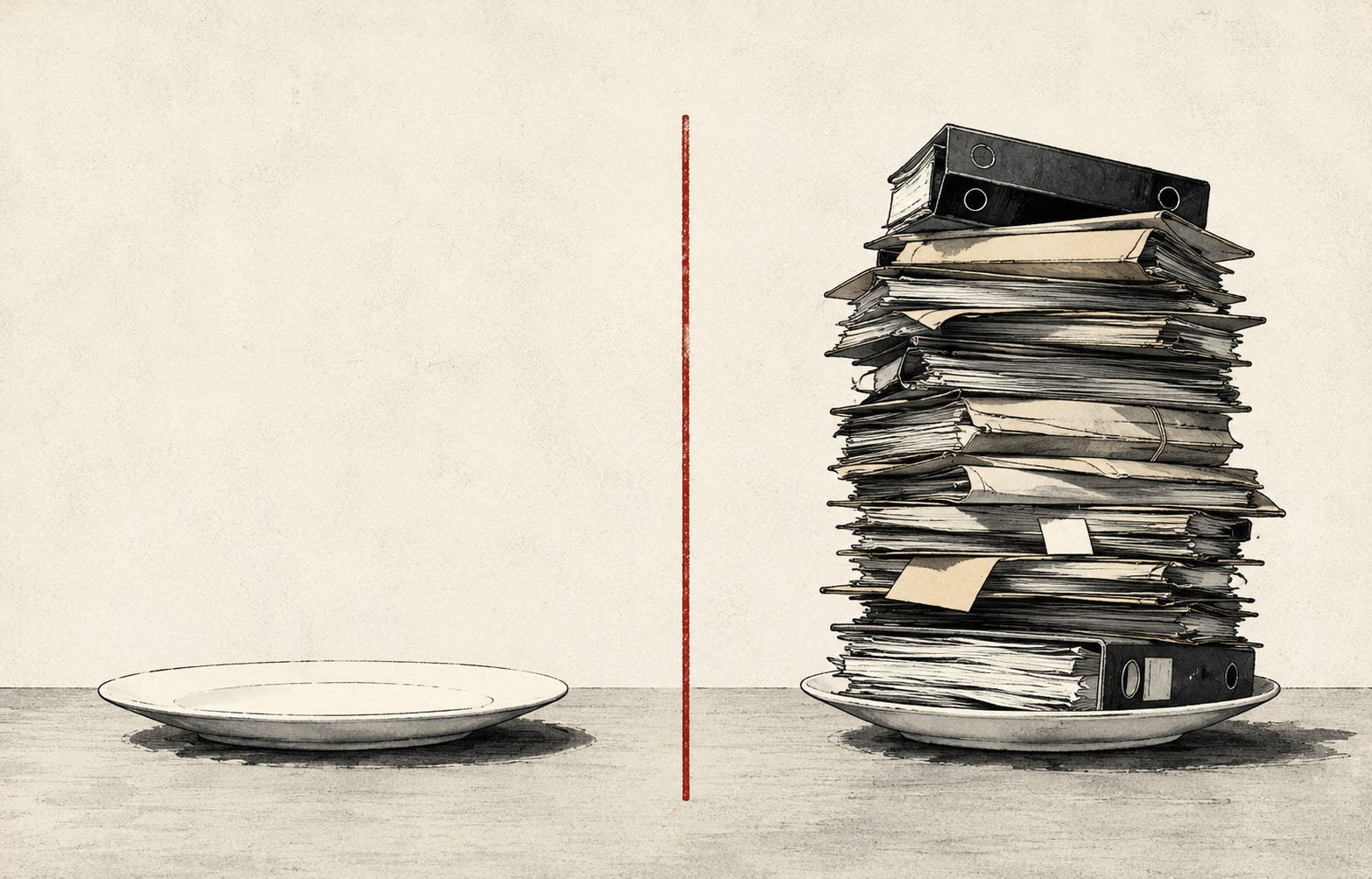
Free Riders
Some executives shed responsibility as they climb, but the organization keeps score.

This is how a career is supposed to work: the longer the tenure, the deeper the experience, the stronger the performance, the more you carry. Bigger projects. Bigger teams. More weight on your shoulders — and, when the world is fair, more pay to match. That’s the deal.
Some executives run the deal in reverse.
They reach a pinnacle, and then the responsibilities start coming off. The bold ones don’t even wait for it to happen — they walk into their boss’s office and ask for it: take these projects off my plate; I’m “too busy;” you figure out who absorbs the weight. These are what I call Free Riders.
Now, if you think this ends in an automatic firing, a demotion, a write-up — or, for the more delicate cases, a quiet deposing — you’d be wrong. It all depends on the organizational culture, and specifically on the higher-ups. Put an inept manager above a Free Rider, and the projects simply get rerouted to whoever delivers. The Free Rider stays exactly where they are.
For a while.
Culture changes. Bosses get transferred, moved, fired. It never ends well for the executive who sheds responsibility, because Free Riders always carry a target on their back. Colleagues will shake their hand, smile, laugh at their jokes — make no mistake, most organizations eat their own, and they eat these executives first. Sabotage. Political maneuvering. Outworking them into irrelevance, until everyone can see who carries the organization and who adds nothing to it. Sometimes all of the above.
You’ve watched this play out at the highest level:
Travis Kalanick, Uber (2017). The board didn’t fire him outright. First came the “review and reallocation” of his responsibilities, an independent chair to box him in, a “leave of absence.” Only then, under investor pressure, did he resign as CEO — keeping a board seat for two more years before being pushed out completely.1
Dennis Muilenburg, Boeing (2019). The board stripped him of his chairman title and left him as CEO — to “focus on the 737 MAX fix,” they said. Ten weeks later, they fired him outright.2
Adam Neumann, WeWork (2019). Facing an investor revolt ahead of a failed IPO, he first surrendered majority voting control and stepped back from day-to-day power. Weeks later, he was forced out of the CEO seat entirely.3
The pattern is identical: stripping responsibility is a visible, escalating signal that removal is coming. And when the position is too delicate to handle directly, the executive gets cast out — ego and all — into some faraway corner of the organization. The stripping buys the company time. Months, sometimes years. It is never the permanent solution.
So why does this keep happening? For that, we have the Peter Principle. A large empirical study of more than 200 firms found that companies systematically promote on current-role performance — even though current-role performance negatively predicts how well someone manages after the promotion. The trait that actually does predict good management, collaboration, is the one firms largely ignore.4 Some people shed work as they rise. But the deeper problem is the promotion machine itself: it keeps elevating people who were never built to carry more. Reverse delegation is the natural result.
Meanwhile, the organization pays. When a Free Rider’s projects land on everyone else’s desk, it spreads like a contagion. In a survey of 1,700 professionals, 54% said low performers foster “a lack of initiative and motivation” — mediocrity gets normalized, and the standard erodes for everyone. Worse: it’s the best people who leave, not the Free Rider. The high performers absorbing the extra load are exactly the ones with options.5
And who’s the main culprit in all this? HR? No. It’s never HR, or Organizational Development, or whatever your company calls it. It’s the culture — set by leadership, carried by colleagues. That is what decides whether a Free Rider gets away with it.
So when you see this in your workplace, don’t waste your anger on the Free Rider. Look at your team and your leadership, and decide what you’re willing to tolerate.
And if the answer is nothing — there’s always The Resistance.
I’m a firm believer that people make the culture and leadership sets the example. The Marines have an infamous ritual for the recruit who won’t carry his share. Organizations run their own version — no blankets required. Call it what it is: auto-regulation. And auto-regulation is a good thing, as long as its objective is the betterment of the organization. When hearts and minds are in the right place — when loyalty runs to the organization and not to any one person — teams take matters into their own hands.
The research backs this up. Fehr and Gächter’s landmark public-goods experiments found that when formal enforcement is absent, group members punish free riders themselves — at real cost to themselves, with no material payoff — and that this “altruistic punishment” alone sustains cooperation that would otherwise collapse.6 Two details matter. The punishment scales with how far the free rider drifts from the group’s standard. And it stops the moment they pull their weight again. A thermostat, not a vendetta.
Oh, and if you think there’s no legal basis for any of this — guess again. In the US, Section 7 of the National Labor Relations Act protects “concerted activity” for “mutual aid or protection” for all private-sector employees, union or not. Comparing notes, documenting a pattern, jointly raising it with the boss’s boss — all protected activity, and disciplining people for it is an unfair labor practice.7
It works, even against protected people:
Uber (2017). Susan Fowler wrote down what HR had ignored — a documented pattern of harassment and retaliation. Her post gave Uber’s employees, then its board and investors, the evidence to act where management hadn’t. Within four months, Kalanick resigned, and roughly twenty others were fired.
Google (2018). When it came out that the company had handed a $90 million exit package to an executive accused of misconduct, twenty thousand employees walked out worldwide. Organized, collective voice — and it produced policy changes management had never made on its own.
Bon Appétit (2020). Staff — led by employees of color — organized a boycott of the outlet’s own video content over a discriminatory culture management had never addressed. The editor-in-chief resigned within days.
In every case, management had the information and the standing to act. They didn’t. The colleagues did.
So what am I saying? You have more power than you think — as a collective. Free Riders are a nuisance, but they’re also an opportunity: a reason for an organization to close ranks and force the top to act. To me, that’s the ultimate show of loyalty — an organization policing itself for the right reasons, standing up for what’s right.
Do it, and the ship turns.
––––––––––––––––––––––––––––––––
1 Business Insider and CNN reporting on the 2017 Uber board actions and Kalanick’s resignation.
2 CNBC (October 2019) and The New York Times (December 2019) on Muilenburg’s removal.
3 Reuters, September 2019, on Neumann surrendering control at WeWork.
4 Benson, Li & Shue, “Promotions and the Peter Principle,” Quarterly Journal of Economics; NBER Working Paper 24343.
5 Eagle Hill Consulting national attrition survey of 1,700+ professionals.
6 Fehr & Gächter, “Cooperation and Punishment in Public Goods Experiments,” American Economic Review, 2000.
7 NLRB, Section 7 concerted-activity protections; Phoenix Transit Systems v. NLRB.