On Founders and Operators
The skills that start a company are not the skills that scale it.

Founders are not always operators. Operators are seldom founders. Very few founders can become great operators — or get out of their own way and let the operators run the organization.
Founders start something from nothing, driven by vision and grit. To be a founder means you had a vision and manifested it into something tangible and physical — a business. Operators take this “thing” that didn’t exist and run it as efficiently as possible, with the sole purpose of making it profitable. Some enterprises stay highly lucrative while staying nimble and compact; others require expansion in line with the founder’s vision. It’s the operator’s job to build the organization — and the people — that can get there.
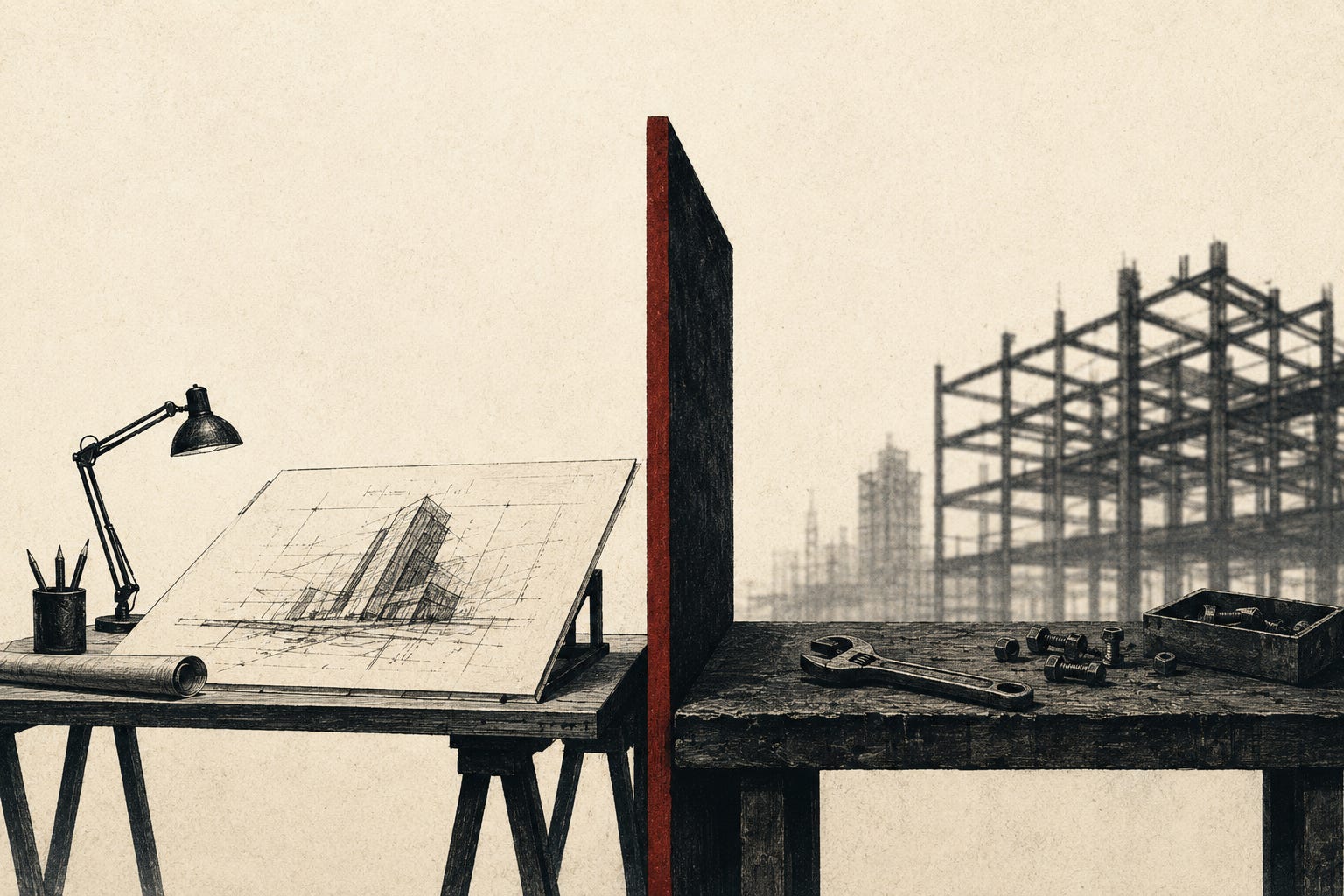
You have an architect and an engineer, and they seldom can do the same work. Many companies don’t make it past the founder because they fail to understand this at a core level. It’s ego-driven — a failure to understand the roles and what each team member is good at professionally.
Many companies get stuck in “founder mode,” where the skills and vision that made the company possible become the bottleneck that stops it from scaling. The patterns repeat across the industry:
1. The founder cannot evolve and keeps dragging the organization to chase new ideas instead of building the proper system around the core of the business.
2. Some call it micromanagement; founders call it “hands-on control.” They want to keep standards high without trusting anyone in the organization until everything is perfect — in their eyes — so everything routes through them. No decision gets made without the founder knowing and approving it, explicitly or tacitly.
3. Organizational processes are created, modified, and re-modified by the founder. There is no movement to codify processes or explore better, more efficient systems at any level.
4. Absolute refusal to make the investment in seasoned veterans and leaders who would bring the horsepower to grow the organization at the scale it needs.
5. Total misalignment between the founder and the operators: the founder insists on talking about the possibilities and “upside” of potential ideas or deals while operators talk about the reality at hand. Very few founders can tolerate that. If these differences are not resolved, the organization stays at an operational standstill.
Ego, every time.
A small set of founders evolve with the company. They internalize the belief that the skills and methods that got them from zero to where they are are not the ones that keep the company growing and maturing. These founders are learners of business mastery. They analyze other companies to identify successful strategies and failures, constantly remaining students of the field. For them, all-in means showing up every day knowing that they do not know. They understand that growth requires investing in human talent, and that surrounding yourself with a team smarter and more talented than you is not a threat. It’s the move. The same disruptive mentality that built the company now builds proper systems, training, and hiring. Most importantly, they take constructive criticism and build a culture of after-action reviews — what went well, what didn’t — so there’s continuous improvement at all levels. Accountability is part of the growth recipe.
One of the most famous founders who failed at this was Steve Jobs — fired from Apple. Jobs 1.0 (1977–1985) was an incredible founder with erratic, abusive management: forced all-nighters, employees sorted into “stars” and “idiots,” the infamous termination in an elevator, tantrums, blatant favoritism, messy meetings — a chaotic work environment inside Apple. He excelled at vision, product taste, and inspiring a small band of believers. He sucked at building stable systems, running a larger organization, or working through others rather than by force of personality. The board removed him in 1985 — a stark example of a founder hitting the leadership ceiling.
Twelve years in the wilderness — NeXT, then Pixar — and he evolved. In an interview, he said he doesn’t believe in “just buy into the decision” leadership, where you overrule people and pressure them to support a decision they think is wrong. Instead, he described getting everybody really involved in that decision into a room and talking until they agree, because you’re paying them to tell you what should be done, not just to execute orders. And he emphasized that there are only a handful of truly important decisions each year. Prioritization and focus, not constant thrashing.
He returned to Apple in 1997, to a bloated company that had lost its way. His first move was to evaluate what was what inside the organization and refocus it on its core business. He cut roughly 70% of the product line, canceled Newton, and concentrated the company on a few core machines and, later, the iMac. That is an operator decision as much as a visionary one: fewer SKUs, clearer priorities, cleaner manufacturing and marketing. In 1998, he hired Tim Cook to fix Apple’s dysfunctional manufacturing processes. Cook closed Apple’s own factories and adopted a contract-manufacturing model in Asia, especially China. Inventory turns improved dramatically. The cost structure improved with them. And that cash funded the product bets Jobs wanted to make. Jobs 2.0 was not personally the operator — but unlike Jobs 1.0, he recognized that obsessive product vision must sit atop world-class operations, and he brought in and empowered the right operator to build that layer.
Then he unified the company. When he returned, Apple was divided into business units competing against each other, each with its own financial statements and sixteen separate advertising budgets. He eliminated the General Manager model and turned Apple into a functional organization: people own design, engineering, and marketing across all products instead of defending silos. One Apple, one brand, one way of communicating. He killed the internal fight over who gets credit for profits. Meat-and-potatoes operational basics: simplify the structure, eliminate incentives that cause rifts, centralize what aligns the company.
When he came back in 1997, Apple was near bankruptcy, losing over a billion dollars. Within a year, it posted a $309 million profit. He launched “Think Different,” which sold no features. It rebuilt Apple’s identity around rebels and creatives — Einstein, Gandhi, Picasso — to unify employees and customers around one story. He bet hard on the iMac, stripping legacy features like the floppy drive in favor of USB and the internet: a willingness to abandon the past and concentrate resources on the future. This is Jobs still being Jobs — radical focus, storytelling, taste — now deployed inside an operational frame he consciously designed.
Herein lies the difference between Jobs 1.0 and Jobs 2.0. It isn’t taste or intelligence. It’s that the second version understood that vision without operational design is fragile. He came back not just to invent products but to redesign Apple’s operating system as a business. He stopped seeing talent as extensions of his will and started seeing them as the brains of the operation — you don’t bring in smart people just to take orders; you bring them in to shape what gets done. He gave A players problems to solve, not tasks to complete. He shifted from fixing people’s mistakes himself to helping them learn because he wanted a team that could win over the long term, not just survive the next Wall Street launch.
Jobs never became an operator. What changed is that he stopped needing to be one. He found his engineer, handed him the building, and went back to being the architect — this time on purpose.
That’s the test. Can you look at the thing you built from nothing and admit it now needs skills you don’t have?
The architect draws it. The engineer builds it.
Know which one you are.